Friday, January 20, 2012

Herons, Bitterns, and Egrets

Geographical Range
The general range for this bird group extends from the upper regions of the United States down to Mexico and Central America. These birds generally live in the northern areas of the United States and into Canada in the summertime, migrate through the middle and southern regions of the United States, and then live in Mexico and Central America in the winter. They generally live along the coasts year-round including the coast of California, south of Virginia, and along the Gulf.

Some exceptions include the Great Blue Heron which live in the majority of the United States year-round, the Little Blue Heron, the Tricolored Heron, and the Yellow-crowed Night Heron which live in the south east quarter of the United States, and the American Bittern which is only seen along the Pacific coast year-round.

Common Features
All are wading birds found in marshes and wetlands. They are carnivores with a diet consisting mostly of amphibians, reptiles, insects, and fish.

The general body shape consists of a stocky body with a long neck and bill and long legs with un-webbed feet. Many also have the ability to retract and extend their neck.

Differences
All three are in the same family, but only bitterns are taxonomically different. There is no real taxonomic difference between a heron and an egret. The main difference is in a generalization that egrets tend to be all white and have wispy feathers.

Bitterns also tend to nest in reed beds along the water while herons and egrets rest in trees.

Birds
American Bittern
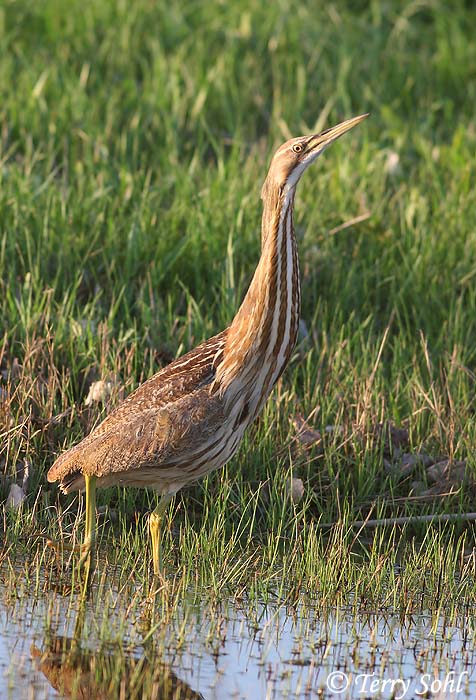


Stocky heron shape
Brown, tan and white stripes
Thick neck and bill
Keeps under cover most of the time


http://sdakotabirds.com/species_photos/wading_largewater/american_bittern_1.jpg

Least Bittern


"Tiny" heron
Long neck and bill
Dark back and head
Brown sides
White and orange chest
Notoriously difficult to spot


http://www.allaboutbirds.org/guide/PHOTO/LARGE/KTK_031504_100102_S.jpg

Yellow-Crowned Night-Heron


Black face and bill
White cheek
Yellow crown
All grey body
Yellow/Orange legs


http://www.animalspot.net/wp-content/uploads/2011/12/Yellow-Crowned-Night-Heron-Images.jpg

Black-Crowned Night-Heron


Medium-sized, stocky heron
Short neck
Black bill
Black back and crown
Yellow legs


http://rebelheart.squarespace.com/storage/bloggarbage/bBlackCrownedNightHeron.jpg?__SQUARESPACE_CACHEVERSION=1278357737891

Green Heron


Small
Keeps neck tucked in to its body
Dark colors
Red/brown body
Green on wings
Long, yellow legs
Long, pointed, dark-colored bill


https://blogger.googleusercontent.com/img/b/R29vZ2xl/AVvXsEiDufvWY-Hlk9uo8OlYBW0F-R4JYlXShysu_I48AYHP829XVEQxnQG-3UrlnPsDnuzuFjxG303ZZYgEB9DlugZxBx6KmBIu4adL7R70VQ81ieD7cWCbKb3hUu5ojwAP4agATbp0Q3RVB2s/s1600/Green-Heron-2.jpg

Tricolored Heron


Medium-sized
Long, slender neck and bill (s-curve)
Dark back/neck
White belly
Tricolor is reference to the blue feathering on wings, white of the belly, and reddish-brown coloring on back


http://71.18.4.194/images/Tri-colored%20Heron%20-%20Texas%2004-06016.JPG

Little Blue Heron
Medium-sized
One color: dark blue/grey
Long neck, bill
Bill has dark tip
Long legs
First years are pure white, adults blue


http://www.flickr.com/photos/lenblumin/2212765402/sizes/o/in/photostream/

Great Blue Heron


Largest heron in North America (about 4 ft.)
Grey-blue color
Black markings on wing
Long black/white crown


http://z.about.com/d/sanfrancisco/1/0/C/B/-/-/greatblueheron.jpg

Cattle Egret


Medium-sized
All white body
Thick yellow bill
Shorter neck
Follows cattle, horses, and tractors to catch the insects they stir up


http://nathistoc.bio.uci.edu/birds/ciconiiformes/Bubulcus%20ibis/Cattle%20Egret,%20adult%20non-breeder%20(Jensen%20Beach,%20FL.,%201-08).jpg

Snowy Egret


Medium-sized
All White
Black legs with yellow feet
Dark bill
Long and thin neck, bill, and legs


http://dance3in23the88rain.files.wordpress.com/2010/09/dwp-snowyegret-rodneywiley.jpg

Great Egret


Large
All White
Long black legs and feet
Long, yellow bill
S-shaped neck
Lacy/fluffy feathers


http://world.std.com/~eva/florida/nuptual_plumage.jpg

Tuesday, January 17, 2012

January 17th Field Trip (Tuesday Lab)

Today we went to Lion's Bridge. We saw:

1. Great Blue Heron


Very tall bird with long legs and big feet, black feathers running from the eye past the back of the head, blue-grey color, some rust-colored feathers on breast/neck.
http://www.flickr.com/photos/mikebaird/490785635/sizes/l/in/photostream/

2. Hooded Merganser


Fan-shaped head with triangular white patch; patch doesn't extend all the way around the head. (Female is just rust colored, no white patch).
http://www.flickr.com/photos/lenblumin/2142693462/sizes/z/in/photostream/

3. Turkey Vulture


Large bird, eats carrion (dead stuff), bald red head, underwing is silver.
http://www.flickr.com/photos/gcwest/442842120/sizes/l/in/photostream/

4. American Robin


Bright orange-red breast, rest of body is black/brown.
http://www.flickr.com/photos/goellnitz/4385300099/sizes/l/in/photostream/

5. Mallard


Green head (might sometimes look blue), blue wing patch; females brown with blue wing patch.
http://www.flickr.com/search/?l=cc&mt=all&adv=1&w=all&q=mallard&m=text


6. Ring-billed Gull


Yellow bill with a black ring around the end.
http://www.flickr.com/photos/texaseagle/4340441171/sizes/z/in/photostream/


Thursday, January 12, 2012

January 12th Field Trip (Thursday Lab)

The first place we visited today was Lion's Bridge. We saw:

1. Ring-billed Gull


Has a black ring around the end of its yellow bill
http://www.flickr.com/photos/34093448@N05/5445948530/sizes/l/in/photostream/

2. Hooded Merganser


Has a wedge-shaped head with a large white patch

3. Mallard


Green head and blue wing patch

4. Double-crested Cormorant


Diving bird with a snake-like head/neck - can usually be found sunning itself like in the picture above
http://www.flickr.com/photos/lenblumin/2163249919/sizes/z/in/photostream/

5. Pied-billed Grebe


Diving bird with a small, chicken-like head

6. We heard, but did not see this bird: Tufted Titmouse


Grey bird with a tuft of feathers on its head and rust colored feathers under its wings
http://www.flickr.com/photos/hmclin/1561886456/sizes/z/in/photostream/

-----

The second place we went to was Huntington Park. The only new bird we saw there was:

1. American Wigeon


Head has green patch, front of head is bright white
http://www.flickr.com/photos/richardwc/5497033785/sizes/l/in/photostream/

Dr. Sherwin's Ducks and Geese


1. Canada Goose


- Large bird with black neck and head and white chin strap
http://www.flickr.com/photos/11561957@N06/5625107976/

2. Brant


- Similar to Canada Goose, but it has a white patch/design on this throat instead of its chin
http://www.flickr.com/photos/mr_t_in_dc/6591831571/

3. Tundra Swan


- Large bird with a long neck; the bill is black and has no protuberance/bulge
http://www.flickr.com/photos/34323709@N07/4432401551/

4. Mute Swan

- Looks like the Tundra Swan except it has an orange bill with a black protuberance
http://www.flickr.com/photos/dave-rogers/370323766/

5. Wood Duck


- Very colorful, easy to ID
http://www.flickr.com/photos/dave_morrison/4501451636/sizes/z/in/photostream/

6. Muscovy Duck


- Has lots of red tumory-warts around its bill
http://www.flickr.com/photos/kevincollins/87937960/sizes/l/in/photostream/

7. Mallard


- Green head with blue speculum
http://www.flickr.com/photos/yeliseev/6587632971/sizes/l/in/photostream/

8. Gadwall


- Looks like nothing else, look for the black rump
http://www.flickr.com/photos/lenblumin/2143818643/sizes/z/in/photostream/

9. Green-winged Teal


- Large green patch behind the eye and has a green speculum
http://www.flickr.com/photos/opusbloo/4198769179/sizes/l/in/photostream/

10. American Wigeon


- Similar to the Green-winged teal, but the front of the head is white
http://www.flickr.com/photos/howcheng/3018696718/sizes/z/in/photostream/

11. Northern Pintail


- Long neck and tail with black and white stripes that travel up the neck
http://www.flickr.com/photos/lenblumin/2211028216/sizes/z/in/photostream/

12. Northern Shoveler


- Has a huge bill and rust and white body
http://www.flickr.com/photos/opusbloo/4198769127/sizes/z/in/photostream/

13. Canvasback


- White back with bill that seems to come from the forehead, red eye
http://www.flickr.com/photos/shellgame/5507198905/sizes/l/in/photostream/

14. Redhead


- Looks like the canvasback except bill seems to start below the eye, yellow eye
http://www.flickr.com/photos/lenblumin/6623974051/sizes/l/in/photostream/

15. Ring-necked Duck


- Has 2 white rings on its bill
http://www.flickr.com/photos/rjproduct/4671763552/sizes/l/in/photostream/

16. Lesser Scaup


- Looks like the ring-necked duck except its bill has no white rings
http://www.flickr.com/photos/rick_leche/63486621/sizes/z/in/photostream/

17. Surf Scoter


- Large white patch on the back of its head/neck, bill is very colorful
http://www.flickr.com/photos/mizmak/4275275968/sizes/l/in/photostream/

18. Bufflehead


- Puffy head with a large white triangular spot on the back
http://www.flickr.com/photos/mr_t_in_dc/6610441011/sizes/l/in/photostream/

19. Hooded Merganser


- Similar to the bufflehead except the head is fan shaped not round, the white patch does not travel complete around the back of the head like the buffleheads does, yellow eye
http://www.flickr.com/photos/seaotter/5719948797/sizes/l/in/photostream/

20. Double-crested Cormorant


- Awkward bird with a long, snake-like head; sits low in the water and is usually seen drying its wings out in the sun
http://www.flickr.com/photos/pfsullivan_1056/3798798170/sizes/l/in/photostream/

Wednesday, January 11, 2012

Hello

Welcome to CNU's Spring 2012 Ornithology Lab Blog!